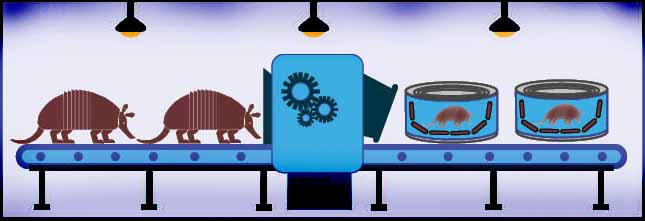
Of all mammals, the armadillo arguably possesses the best protection against punctures and jabs. Once it curls into a defensive sphere, the animal’s outer armor makes it all but impervious to the hazards it typically encounters, from coyote teeth to bobcat claws. If you believe the internet, the dillo’s hide is so tough that bullets sometimes bounce off it.
Contrast this with what is almost certainly the thinnest-skinned creature in nature—the prose writer.
To put it plainly, authors don’t react well to seeing their work skewered. They sometimes feel the stroke of a red pen as keenly as a hypodermic needle to the gumline. This goes for novices and veterans alike.
A Grisly Metaphor
I recall hearing some years ago an interview with Margaret Atwood, the best-selling novelist whose dystopian vision has become a cultural touchstone. During it she described the process by which her words are prepared for publication as akin to sausages grinding their way through the sausage factory.
At that time in my career I was more on the editing side of things and took offense at this metaphor. Since shifting back to a focus on providing written content I have come to sympathize with Atwood’s view.
Part of the problem is that to even aspire to write you have to be something of an egotist. Because being published is so fraught with perils—from ridicule to litigation—it requires a certain amount of arrogance to eschew the dangers and get on with the work.
Consequently, when we scribes hand off our completed drafts to first-line editors, we imagine them dropping their scarlet Sharpies and weeping tears of joy at the perfection set before them.
The reality is quite different. The barbs come fast. And they sting.
No Pain, No Gain
There are many reasons for this. To begin with, communication of any kind is painfully difficult, which means even the clearest prose sometimes fails to click with even the most perspicacious of editors. Then there’s the trend in our faster-than-instant digital era of readers not wanting to take the time to really read.
I ran into this problem during a group review of an article I wrote for work about something that happened in Delaware, Ohio. One editor suggested we take pains to clarify that we were referring to a place in the Midwest, and not a tiny state on the eastern seaboard. It was all I could do to keep the anguish out of my voice when I replied, “Oh, you mean like I wrote in the second paragraph?”
Then there are those times when what you write, however well-crafted, doesn’t match the publisher’s vision. My boss once gutted whole sections of what I felt was a detailed, nuanced account of a family caught in a thorny legal dilemma. His concern was more business-related than literary; he insisted anything more than a straightforward telling would contradict our corporate messaging about the services we provide and why. Still, the changes made me feel as though my narrative had been reduced to a marketing blurb.
You Only Hurt the Ones You Love
All these complaints aside, it’s important for writers to remember how much we need editing. If you’ve ever proofed longer projects such as magazines and books, you’ll know how excruciating it is to ferret out all the miscues. There’s always so much to consider and so many words to comb through.
Have all the facts been checked? Does every reference to someone with a title conform to guidelines laid out in the CMS (or AP, or by Ms. Turabian)? Will that solitary, throw-away joke your featured columnist is in love with end up antagonizing half the readership? How do you spell coelacanth?
The truth is you have to have a team of editors because the work is so hard and tedious. And asking authors to vet their own prose is risky because they hold a built-in bias against making changes—and have a natural blind spot to errors.
Though I shudder to admit it, good editors are a writer’s friend. Anyone who hopes to be considered an auteur would be well-advised to cultivate relationships with those wielders of red ink—for their own good.
In other words, the next time you hand in your manuscript for review, take a lesson from those armored mammals. Instead of wincing at the prospect of having your words scrutinized, simply take a deep breath, circle up your insecurities, and channel your inner armadillo.
 Dave Dentel